

Governments face mounting pressure to improve efficiency, reduce costs, maintain regulatory compliance, and deliver seamless public services.
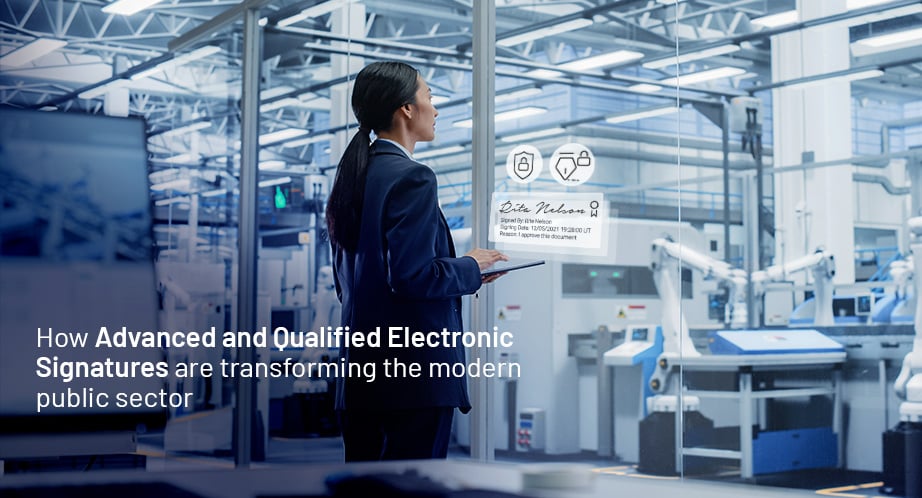
Traditional paper-based processes, burdened by manual handling, postage delays, and labour-intensive administration, are no longer sustainable. Advanced Electronic Signatures (AES) and Qualified Electronic Signatures (QES) are now enabling faster, more secure, and more citizen-centric public sector operations.
Where remote signing is required, both signature types can be delivered through secure remote authorised signing, with Qualified Remote Signing providing the highest level of legal assurance under eIDAS.
In this blog, we’ll explore:
- What electronic signatures are, and how Advanced Electronic Signatures and Qualified Electronic Signatures differ
- Where hidden costs persist in traditional public sector workflows
- How digital signing reduces inefficiency, delay and risk
- Why remote signing matters, and when Qualified Remote Signing is needed under eIDAS
- Real world government use cases
- How Ascertia’s SigningHub and ADSS Server bring these capabilities together
- What comes next in security, compliance, sustainability and digital resilience
What are advanced and Qualified Electronic Signatures?
Electronic signatures are a broad category of methods used to indicate agreement or approval in digital form. Within that broad category, the two most relevant trust levels for regulated public sector workflows are Advanced Electronic Signatures (AES) and Qualified Electronic Signatures (QES).
An Advanced Electronic Signature is cryptographically bound to the signed content, linked to the signer, and capable of detecting any later changes to the document. This makes AES well suited to workflows that require strong integrity, authenticity and auditability.
A Qualified Electronic Signature is a specific type of electronic signature defined under the EU eIDAS Regulation. It builds on the controls of an advanced signature but must be created using a qualified certificate and a qualified signature creation device or service. Under eIDAS, a QES has the equivalent legal effect of a handwritten signature.
Both AES and QES can be delivered through remote signing models. Where a qualified signature is created remotely, typically through a Qualified Trust Service Provider (QTSP) using certified infrastructure, this is commonly referred to as Qualified Remote Signing.
The hidden costs of paper-based public sector workflows
Paper-based processes remain surprisingly expensive, even when digitisation is underway elsewhere. Here are a few examples of daily hidden costs linked to paper-based processes:
- Ink and Paper – Key cost drivers include ink and paper for printing and with hundreds or thousands of documents processed daily, costs accumulate quickly.
- Physical storage – Filing cabinets, archives, transport and even off-site storage rentals all add up.
- Labour and time – Printing, scanning, filing, and chasing signatures all cost valuable time and effort.
- Postal and courier fees – These can cost into the thousands for inter-agency or inter-regional document transfers.
- Error, loss, and rework – Form filling mistakes, misplaced documents, and failed deliveries cause delays, public frustration, and wasted resources.
How electronic signatures reduce costs and improve efficiency
Public sector organisations are under increasing pressure to do more with less. Budget constraints, legacy systems and manual processes all slow down operations and increase overheads.
Electronic signatures offer a proven way to streamline workflows while reducing both direct and indirect costs. For public sector organisations handling high volumes of approvals, forms, contracts and citizen records, the impact can be substantial. Here is how adopting electronic signatures leads to measurable savings across key areas of government operations:
- Eliminating printing and postage – Digital workflows remove the need for paper, ink, envelopes and courier services. No physical handling means no material waste or delivery delays.
- Reducing physical storage and retrieval costs – Electronic documents can be stored securely in cloud or on-premises, without incurring physical storage costs. Retrieval becomes instant and efficient.
- Boosting productivity – Digital approvals can be completed online in minutes, not days. Document circulation is nearly instant, allowing staff to focus on high-value work.
- Avoiding human error – Document sharing is digital and secure, no envelopes, no chance of “lost in transit”, and automatic form validation (i.e., required fields) ensures fewer mistakes.
When Advanced Electronic Signatures are enough, and when Qualified Electronic Signatures matter
Advanced Electronic Signatures already deliver strong benefits in terms of security, efficiency and trust. In many public sector workflows, AES provides the right balance of assurance, usability and operational speed.
However, some scenarios demand the highest level of legal certainty and evidential strength. This is where Qualified Electronic Signatures become particularly important. Under eIDAS, a QES provides the strongest legal standing and is especially valuable in high assurance, high value or cross-border processes.
Where users need to sign without being physically present, Qualified Electronic Signatures can be delivered through Qualified Remote Signing. This allows authorised individuals to sign securely from any location while maintaining the legal and technical controls required under eIDAS.
Here is why QES, including Qualified Remote Signing, is a critical part of a government digital trust strategy:
- Legal equivalence to handwritten signatures under eIDAS
- Stronger identity assurance through verified identity proofing and multi-factor authentication
- Tamper evidence and robust auditability, with clear records of who signed, when, and under what controls
- High trust for cross-border, inter-agency and regulated workflows
- Support for long term compliance, validation and evidential integrity
Real-world government use cases
Advanced and Qualified Electronic Signatures are already transforming how governments operate. Whether deployed through local or remote signing models, they help agencies streamline processes, increase accountability and deliver better citizen services. Below are a few examples of how public sector organisations are putting these capabilities to work:
Procurement and supplier contracts
Advanced and Qualified Electronic Signatures enable fast contract approval without courier delays or disputes about authenticity. Procurement cycles are shortened significantly, accelerating supplier onboarding and service delivery.
Tax and financial forms
Tax authorities can issue, review, sign and return forms digitally, reducing backlogs, improving accuracy and supporting more efficient revenue collection.
Permits, licences, and grants
Citizens and officials can complete, review and approve applications digitally without in-person visits, improving access to essential public services and reducing administrative delay.
Crisis situations
During natural disasters, pandemics or other emergencies, remote signing allows officials to maintain continuity securely and efficiently. Where the highest level of legal assurance is required, Qualified Remote Signing ensures that critical approvals can still be completed with full evidential strength.
Healthcare
Although not the main focus here, healthcare provides a strong parallel. Trusted digital signing supports secure records, approvals and certifications, where integrity, traceability and legal confidence are essential.
SigningHub and ADSS Server: Ascertia’s trusted digital signing platform
Implementing Advanced and Qualified Electronic Signatures requires more than compliance alone. It requires robust, scalable and secure infrastructure that can support strong identity assurance, protected signing keys, auditability and integration into real operational workflows.
Ascertia’s flagship solutions, SigningHub and ADSS Server, provide that foundation for governments and regulated organisations worldwide. Together, they deliver the security, scalability and control needed to support both advanced and qualified signing journeys, including remote signing use cases.
SigningHub – Advanced and Qualified signing made easy
SigningHub enables organisations to deploy secure, scalable digital signing workflows across a wide range of public sector use cases. Built on robust PKI foundations, it supports strong user authentication, seamless signing journeys and remote signing scenarios, including qualified signing models aligned with eIDAS requirements. Key features include:
- Browser and mobile signing from anywhere
- Multi-factor authentication (MFA)
- Batch signing for high-volume, bulk workflows
- Detailed audit logs for legal traceability
- Flexible deployment options, including on-premises, cloud and hybrid models to support sovereignty requirements
ADSS Server – The core trust infrastructure
For deeper workflow integration, backend trust services and high assurance deployment models, ADSS Server provides enterprise grade PKI and digital trust capabilities, including:
- Certificate issuance and lifecycle support
- Signature verification
- Timestamping and long term validation support
- HSM and QSCD integration
- Support for advanced signature formats such as PAdES, XAdES and CAdES
Getting started: Planning an Ascertia powered rollout
Rolling out Advanced and Qualified Electronic Signatures is most effective when approached in phases. Public sector organisations should begin by identifying where stronger trust, faster turnaround and reduced administrative overhead will have the greatest impact. A practical rollout typically includes the following steps:
- Assess workflows – Identify high impact areas for digitisation such as contracts, licences and permits
- Choose your deployment: Cloud, on-premise, hybrid
- Cloud enables faster deployment
- On-premise offers full data control
- Hybrid to balance flexibility and sovereignty
- Select the right signature level
- Advanced Electronic Signatures for workflows that require strong integrity, signer linkage and auditability
- Qualified Electronic Signatures for high assurance, high value or high risk documents where the strongest legal standing is required
- Integrate seamlessly
- SigningHub and ADSS Server integrate via APIs and SDKs with government portals, CRMs, ERPs, and case management systems.
- User authentication and training
- Implement MFA, and support government digital IDs
- Deliver training for internal staff and citizens
- Pilot, refine and scale
- Start with one department
- Refine the process based on feedback and performance
- Expand across the organisation
- Monitor and optimise
- Track key metrics
- Cost savings
- Processing time reductions
- User feedback and satisfaction
- Use insight to continuously improve
- Track key metrics
What’s on the future horizon?
As digital trust technologies mature and frameworks such as eIDAS continue to evolve, governments are well placed to lead the next phase of secure, efficient and citizen-centric service delivery.
The adoption of Advanced and Qualified Electronic Signatures is only part of a wider digital trust transformation. Key trends shaping the future of public sector signing and trust infrastructure include:
- Expansion of digital-first public services to improve accessibility, efficiency and inclusion
- Greater cross-border interoperability through common trust and signature frameworks
- Convergence of digital identity and signing, linking national identity schemes with trusted signing processes
- Broader adoption of advanced PKI capabilities, including HSMs, long term validation, eSeals and registered delivery services
- Sustainability gains through reduced paper use, lower transport demands and smaller administrative footprints
What’s the real impact?
Advanced and Qualified Electronic Signatures give governments a practical path to more secure, efficient and citizen-focused operations. From reducing paper and administrative cost to increasing trust, legal assurance and resilience, Ascertia’s SigningHub and ADSS Server provide a trusted foundation for transformation:
| Benefit | Impact |
|---|---|
| Efficiency and productivity | Up to 80% faster document processing |
| Cost savings | Reduced spend on printing, postage, storage, and labour |
| Security and compliance | Full alignment with eIDAS, eSIGN, UETA, GDPR, audit trails |
| Sustainability | Significant reduction in paper usage and carbon footprint |
| Public resilience | Remote signing supports continuity during emergencies |
As public expectations continue to rise and digital first delivery becomes the standard, the case for trusted digital signing is stronger than ever. Ascertia combines public sector understanding with proven trust infrastructure to help governments modernise securely and at scale.
Ready to take the next step? Explore SigningHub and ADSS Server or speak to our team about building a digital signature strategy that aligns with your operational, legal and sovereignty requirements. Governments adopting Advanced and Qualified Electronic Signatures are not just reducing costs, they are delivering smarter, faster and more resilient public services for the future.
